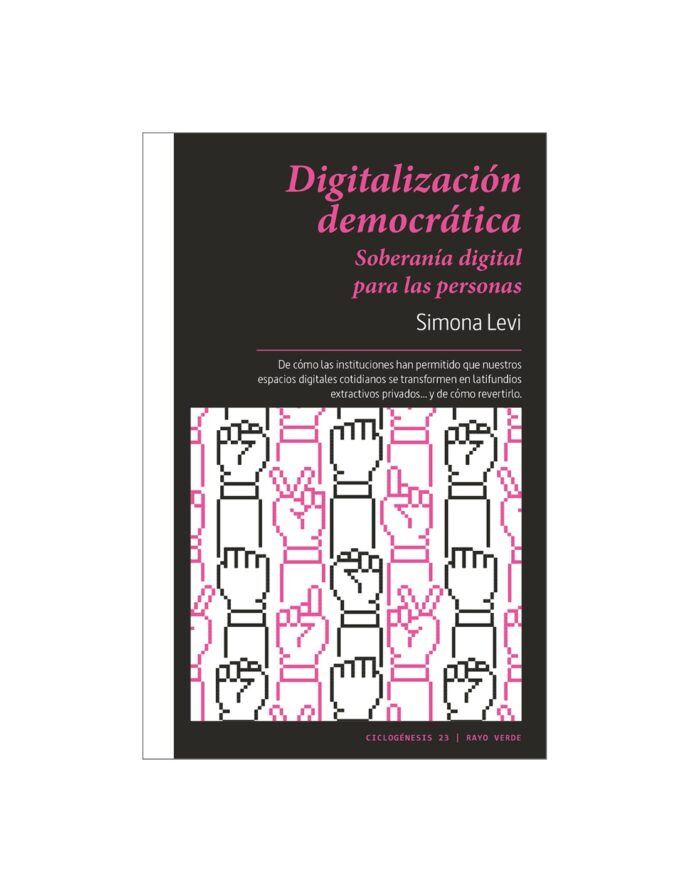
Digital transformation is advancing at an unstoppable pace, yet public debate about it often remains dominated by fear or uncritical opportunism. This raises a central question: is digitalization serving citizens, or is it being built on foundations that threaten fundamental rights? It is in this context that the new essay by activist and technopolitical strategist Simona Levi emerges.
Simona Levi, born in Turin in 1966 and living in Barcelona for over three decades, is the founder of Xnet, a non-profit platform that promotes the defense of digital rights, institutional transparency, and the fight against corruption in Spain. Her experience with Xnet provides her with a direct perspective on the challenges of digitalization and technological governance, combining analysis and citizen action.
Published in September 2024 by the publishers Rayo Verde (Spanish) and Raig Verd (Catalan), the book “Democratic Digitalization: Digital Sovereignty for People” is presented as a tool for citizen action. The work evolves from a 2021 report Levi prepared for the then-President of the European Parliament, David Sassoli, aimed at exploring how to ensure digitalization serves democratic and inclusive purposes.
In the book, Levi delivers a forceful critique of the power of large tech corporations, describing them as “latifundist lords” who have turned everyday digital spaces into “private extractive estates.” She highlights the responsibility of institutions, which allowed companies such as Google, Amazon, Facebook, Apple, and Microsoft to occupy digital public space through dumping practices and non-auditable software.
As an alternative, Levi proposes a model based on three core pillars: mandatory free and auditable software in public administrations, the use of sovereign servers controlled by citizens, and segmented public contracts favoring SMEs over multinational megadeals. Concrete proposals include creating a European public email service or institutional adoption of the Firefox browser.
Through this work, Simona Levi offers a roadmap for a fairer digital future, where technology functions as a public-interest infrastructure, strengthening democracy and restoring citizens’ control over digital spaces against the dominance of major corporations.