
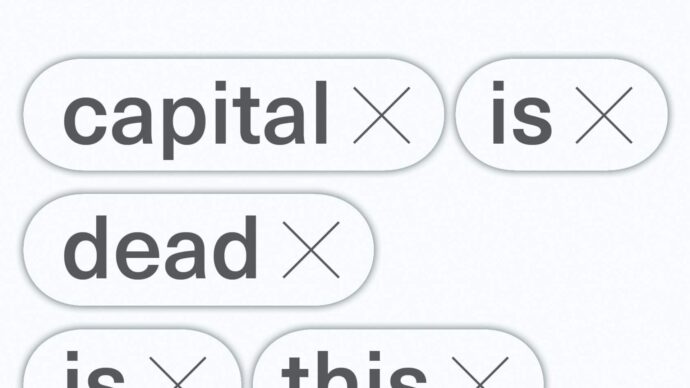
Capital Is Dead: Is This Something Worse? (2019; O Capital Morreu), by McKenzie Wark, presents a provocative hypothesis: industrial capitalism is no longer the dominant system, but has been replaced by another mode of production based on information control. Published by Verso, the essay introduces the concept of “vectoralism” to describe this new economic order.
The object of the work is to identify which system governs the global economy after the 2008 financial crisis. Wark, professor of Cultural and Media Studies in New York, updates Marxist categories to interpret a scenario in which data, algorithms, and digital infrastructures have displaced the centrality of the factory. Her proposal dialogues with critical theory and media studies, maintaining an analytical and professional tone.
The core argument asserts that information is the main productive force of the 21st century. This gives rise to a new dominant class, the “vectoralists,” who control the vectors through which information flows: patents, copyrights, trademarks, algorithms, and logistical chains. It is not just about owning factories, but about dominating the informational flows that organize global production.
The historical context is crucial. After the 2008 financial crisis, digital platforms consolidated, extracting value from the daily activity of millions of users. Scandals such as Cambridge Analytica revealed the power of data to influence social and political behavior. Within this framework, Wark interprets that value extraction no longer relies solely on industrial labor, but on the systematic capture of information.
The work dialogues with analyses such as Nick Srnicek’s “platform capitalism” or Shoshana Zuboff’s “surveillance capitalism,” but goes further by asserting that we are not merely facing an evolution of capitalism, but something potentially worse. Vectoralism describes a system with an expanded capacity to accumulate wealth and neutralize resistance.
Structured in seven chapters, the book combines economic theory and historical reflection. Among its influences are J.D. Bernal and the Situationist International, from which she draws the détournement as a critical tool. For Wark, understanding vectoralism is the first step toward imagining political and cultural alternatives in the 21st century.