
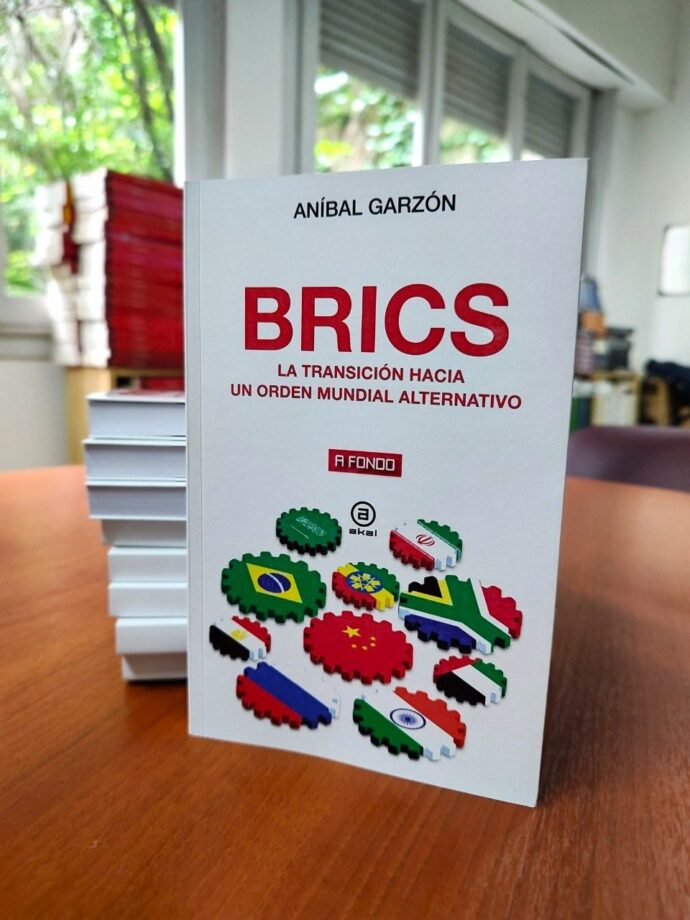
We are living through a time of profound geopolitical shifts, but the dominant narrative still almost always filters through the Western prism. While the powers of the global north debate alliances and sanctions, in the south platforms are emerging that aspire to rewrite the rules of the international game. One such space is the BRICS bloc, and sociologist Aníbal Garzón places it at the centre of the board: “BRICS. La transición hacia un orden mundial alternativo” (Akal, 2024). The work offers a documented guide to understanding how this group of emerging economies is challenging, without ideological fanfare, the monopoly on decision-making that the United States has held for decades.
The bloc, initially formed by Brazil, Russia, India, China and South Africa, has grown to double its membership with countries such as Egypt or Indonesia, among others. This makes the alliance an important subject of study that is difficult to ignore in the current global landscape.
The 256-page book traces the evolution of the BRICS from its gestation to its current phase of maturity, with particular attention to the expansion of members and the search for autonomous financial mechanisms. Garzón, who holds degrees in Sociology and International Studies and has a background in cooperation in Africa and Latin America, avoids oversimplifications. For him, the BRICS do not constitute a homogeneous bloc nor do they export a single model; rather, they operate as a “hybrid and pragmatic scheme” that accommodates national realities as diverse as China’s, Russia’s or South Africa’s. This plurality, far from being a weakness, is their main tool for building a multipolar order without falling into direct confrontation.
The structure of the essay unfolds in eight chapters, ranging from the decline of the unipolar world to concrete proposals for a new financial and monetary architecture. The author stresses that the bloc is not just a trade club; it is also a geopolitical actor capable of influencing global agendas, especially those related to climate change, reforms of the International Monetary Fund and mediation in regional conflicts. The work dedicates a whole chapter to the West, because, as Garzón warns, “if we do not pay attention to the BRICS, we will not understand the changes taking place in the world today”.
The context in which this book emerges is crucial. With the war in Ukraine, tensions in the Taiwan Strait and the reconfiguration of supply chains, the demand for alternatives to the dollar’s hegemony has taken on an unexpected urgency. Garzón does not hide the group’s internal contradictions, but insists that its strategic value lies in offering a counterweight to imperialist policies without falling into Cold War rhetoric.
From a formal perspective, the volume belongs to Akal’s “A fondo” collection and is written in an accessible yet rigorous style, with no concessions to sensationalism. The central thesis is that the current transition is not written in advance: it may lead towards more democratic and plural governance or repeat the mistakes of the past. Garzón bets on the BRICS becoming a laboratory for South-South cooperation, although he warns that the road is full of obstacles, from internal divergences to external pressure.
The book ultimately invites us to look at the map without Western glasses, an uncomfortable but necessary exercise for those who want to understand the coming century. The work is neither a pamphlet nor an apology; it is a tool for understanding the dynamics of a world in reconfiguration, where the voices of the global south claim a space that until now had been denied to them.
Sources:
-
Editorial Akal (2024). BRICS. La transición hacia un orden mundial alternativo. https://www.akal.com/libro/brics_53759/
-
Wikipedia (2026). BRICS. https://gl.wikipedia.org/wiki/BRICS
-
El Salto Diario (2025). Aníbal Garzón: “EEUU es una economía de guerra y los BRICS le vienen bien para justificar su escalada militar”. https://www.elsaltodiario.com/rio-arriba/anibal-garzon-eeuu-es-una-economia-guerra-brics-le-vienen-justificar-escalada-militar
-
Nueva Revolución (2024). BRICS, la transición hacia un orden mundial alternativo. https://nuevarevolucion.es/brics-la-transicion-hacia-un-orden-mundial-alternativo/