
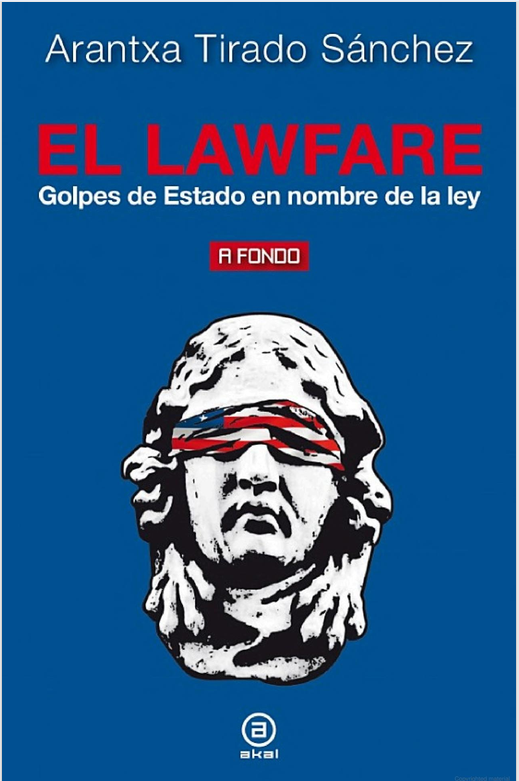
The book El lawfare. Golpes de Estado en nombre de la ley, by political scientist Arantxa Tirado Sánchez, was published in 2021 as an analysis of the strategy through which left-wing governments are undermined through the courts, without the need for tanks. The book responds to a specific reality: the rise to power of left-wing governments in Latin America from the end of the 20th century onwards created a geopolitical map that was adverse to US public-private interests in the region. In order to alter this balance of forces, lawfare came onto the scene: an apparently democratic and legally grounded mechanism that seeks to undermine the power, public image and chances of re-election of left-wing leaders.
Tirado, who holds a PhD in International Relations from the Universitat Autònoma de Barcelona and is a researcher at the Latin American Strategic Center for Geopolitics, presents lawfare, or judicial warfare, as a military strategy framed within hybrid warfare. The combination of judicial, media, political and economic operations seeks to reshape geopolitics in response to any deviation from neoliberal interests. Unlike traditional coups, which prevented governing left-wing forces from implementing their agenda by usurping power through violence, lawfare performs the same function under the protection of legality while maintaining the appearance of democracy.
The research has a stated objective: to demonstrate that lawfare is a weapon serving to reshape the balance of forces in the post-Cold War international system, in which the United States is experiencing a decline in its hegemony. The book, focused on the Latin American and Caribbean region, examines, among others, the cases of Lula da Silva in Brazil and Rafael Correa in Ecuador. It shows how, whenever there is an attempt at social change aimed at improving people’s lives, a lawfare strategy emerges, supported by the media, to put a stop to it and remove from power those who seek to take measures that threaten US interests.
The analysis warns that this threat is not limited to Latin American territory, which serves as a testing ground. Once the effectiveness of this tool has been confirmed, the book asks what prevents it from being applied in other countries and points to recent indications in that direction.
The book was published in a context of growing concern about US interference in Latin American electoral processes. Thus, lawfare can be regarded as an updating of the Monroe Doctrine adapted to current geopolitical dynamics, in which Washington seeks to consolidate its area of direct influence amid the perception of a decline as a hegemonic power.
Sources
Tirado, A., Akal. (2021). El lawfare. Golpes de Estado en nombre de la ley. https://www.akal.com/libro/el-lawfare_51473/
Crítica Jurídica. (2022). El lawfare. Golpes de Estado en nombre de la ley (review by Érika García Landeros). http://www.criticajuridica.org/index.php/critica_juridica/article/download/687/718/1418
Economistas sin Fronteras. (2021). El Lawfare: Golpes de Estado en nombre de la ley – Arantxa Tirado (review by Jorge García Ruiz). https://ecosfron.org/el-lawfare-golpes-de-estado-en-nombre-de-la-ley-arantxa-tirado/
RTVE. (2021). Arantxa Tirado: “El ‘caso Lula’ ha sido un ejemplo de lawfare, una guerra jurídica”. https://amp.rtve.es/noticias/20210424/arantxa-tirado-caso-lula-sido-ejemplo-lawfare-guerra-juridica/2087587.shtml