
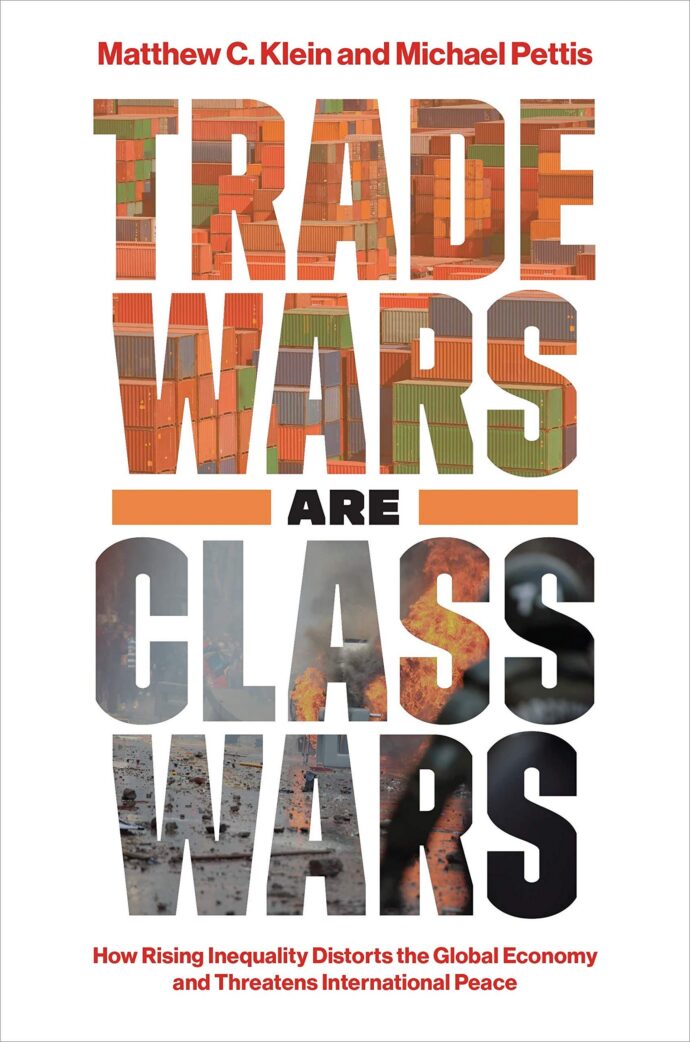
How inequality distorts the economy and threatens international peace. The work of Matthew C. Klein and Michael Pettis argues that tariffs are not a clash between nations, but the shockwave of internal inequality.
In 2020, while the world witnessed the tariff escalation between China and the United States, two analysts published a book that unsettled the conventional narrative on trade conflicts. “Trade Wars Are Class Wars: How Rising Inequality Distorts the Global Economy and Threatens International Peace”, published by “Yale University Press”, argues a provocative central thesis: when a government favors the accumulation of capital by elites at the expense of wages, the majority of the population loses consumer capacity. That excess savings, concentrated in few hands, must be invested abroad, generating massive trade surpluses. China and Germany are the paradigmatic examples. On the other side, deficit countries absorb that surplus and suffer deindustrialization and wage stagnation, which fuels protectionism and geopolitical tension.
Klein and Pettis are not two academics removed from the real world. Matthew C. Klein was an economic commentator at “Barron’s” and wrote for the “Financial Times”. Michael Pettis is a professor of Finance at the “Guanghua School of Management” of Peking University and a nonresident senior fellow at the “Carnegie Endowment for International Peace”. Their combined experience in financial markets and analysis of the Chinese economy gives the work an authority uncommon in geopolitics essays.
The critical reception was notably positive. The book won the 2021 Lionel Gelber Prize, one of the most prestigious awards in international affairs, awarded by the “Munk School” at the University of Toronto. The jury highlighted that the work combines “political and economic analysis with sharp history” to argue that policies benefiting the wealthiest people not only generate internal conflict but also “deepen international rivalries”. Economist Ann Pettifor, in the “Times Literary Supplement”, described it as a “sharp perspective on the global economy”.
Among the criticisms, some economists point out that the book overestimates the class variable and underestimates other factors such as technological competition or military strategies. Nevertheless, its contribution is valuable: it offers a framework that connects wealth distribution within countries with the stability of international relations, a perspective uncommon in geopolitics studies.
Sources
-
Cambridge University Press. Leiden Journal of International Law. https://www.cambridge.org/core/journals/leiden-journal-of-international-law/article/abs/matthew-c-klein-and-michael-pettis-trade-wars-are-class-wars-how-rising-inequality-distorts-the-global-economy-and-threatens-international-peace-yale-university-press-2020-288-pp-2800-isbn-9780300244175/7B0C4DF312694004E93A7011076C2267
-
The Munk School of Global Affairs and Public Policy. 2021 Lionel Gelber Prize. https://gelber.munkschool.utoronto.ca/2021-gelber-prize/
-
Ann Pettifor. Review: Trade Wars are Class Wars, 2021. https://annpettifor.com/2021/01/review-trade-wars-are-class-wars/
-
Dissent Magazine. The Price of Empire, 2021. https://www.dissentmagazine.org/article/the-price-of-empire/
-
Pasajes Librería Internacional. Klein, Pettis (biografía). https://pasajeslibros.com/autores/klein-pettis/156242/