
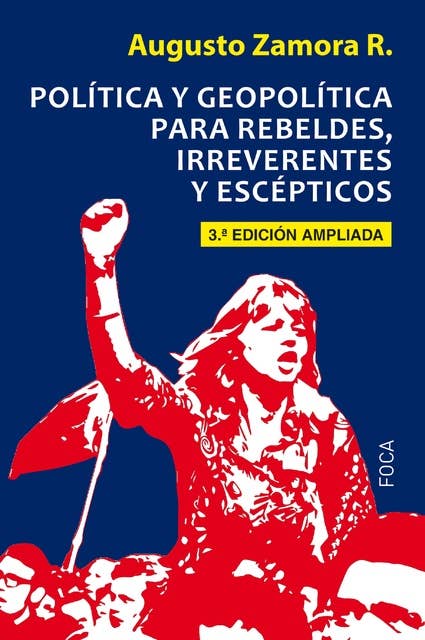
Marx used to say—and Rafael Correa popularized—that press freedom is the freedom of the owner of the printing press. Thus, the information received through major media outlets is increasingly conditioned by a media oligopoly that imposes a Manichaean view of reality. This is the premise from which Augusto Zamora starts in his essay “Política y geopolítica para rebeldes, irreverentes y escépticos” (Politics and Geopolitics for Rebels, Irreverent, and Skeptical), a work that has been updated and expanded and has become a reference in the field of geopolitical analysis. The book proposes “starting from scratch” to understand today’s world, and even to try to change it.
The author is Augusto Zamora (Estelí, Nicaragua, 1954), a figure with a unique career: former ambassador of Nicaragua to the Spanish State until 2013, he was a professor of public international law and international relations at the Autonomous University of Madrid. Previously, he served as legal director of his country’s Ministry of Foreign Affairs and was part of the negotiating team in the Contadora and Esquipulas peace processes. This diplomatic and academic background gives the text an uncommon authority in the genre.
Originally published in 2016 by Ediciones Akal, the book is aimed at a broad audience, with an engaging and ironic tone that does not sacrifice analytical rigor. The work unpacks the concepts, theories, and protagonists that have shaped the sociopolitical context, doing so from a perspective that questions the hegemonic discourse imposed by the major media.
The context in which this work appears is that of a world transitioning from a unipolar order to a multipolar one. Zamora argues that the United States’ attempt to impose global hegemony through wars on three continents ended in failure, and that we are witnessing the return of Russia as a power, the unstoppable rise of China, and an evident decline of Europe with the fall of the imperial hegemon.
Its relevance lies in its vocation as a tool for critical thinking. The last major chapter, titled “Basic Glossary for Self-Protection,” warns about the mechanisms of propaganda and offers resources to exercise the “right to legitimate intellectual and mental self-defense.” Understanding the logics of power and the struggles taking place on the global chessboard is not an academic exercise but a necessity for those who aspire to transform reality. Zamora’s book is, therefore, an invitation to look at the world through the eyes of a “rebel, irreverent, and skeptical” person.